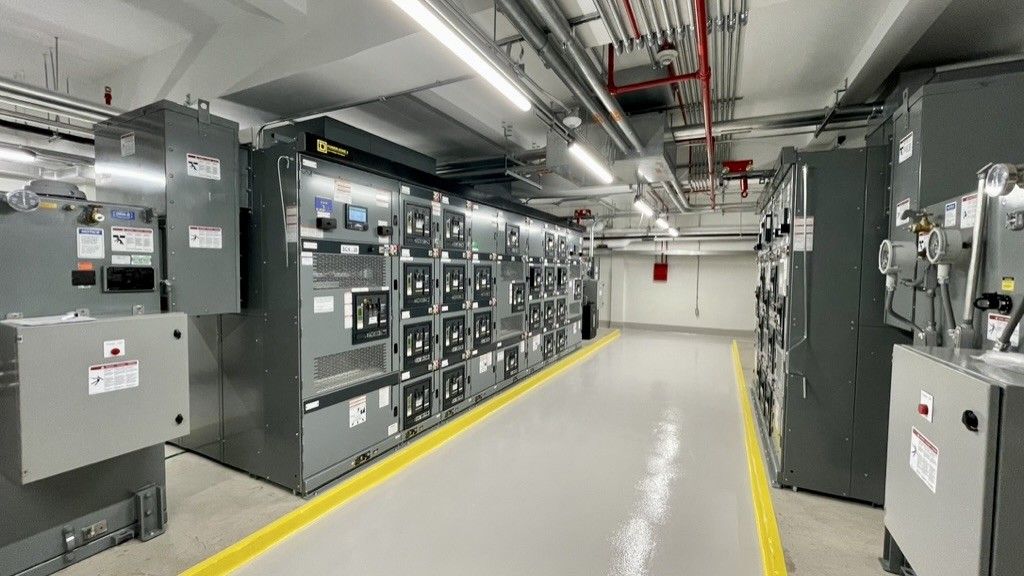
Arc Flash Risk Assessment

Know Your Actual Hazard Level
Without an up-to-date study, a crew opening a panel is guessing at the PPE level required to work safely. An arc flash risk assessment ensures the appropriate PPE level is indicated with a calculated incident energy value and arc flash boundary, among other data, for every piece of equipment that requires it. PPE selection and safe working distances are based on your system's characteristics, not a generic assumption.
What's Included
- Short-circuit and protective device coordination review
- Incident energy analysis calculated to IEEE 1584
- Arc flash boundary and PPE category determination for each piece of equipment
- One-line diagram review, and an update.
- PE-stamped summary report you can produce for an inspector, insurance, or an AHJ to review.
How It Works
- 1
Consultation
We review your electrical service, distribution systems, existing documentation, one-lines, and site conditions to determine the requirements for labeling and the scope of the study.
- 2
Engineering & Calculation
We survey your site(s) to acquire all the needed input data for the study, including any upcoming renovations or alterations to the electrical system that must be accounted for. We model your system and calculate incident energy and PPE requirements at each piece of equipment.
- 3
Report & Labels
You receive a stamped report and compliant labels ready to install.
Standards We Work To
IEEE 1584 (incident energy calculation methods), NFPA 70E (electrical safety in the workplace), and OSHA 29 CFR 1910.269 (incident heat energy exposure estimates for qualified employees).
Get Ahead of the
2026 Labeling Requirements
Schedule a consultation with Rob Currie, PE to find out where your facility stands under the updated NEC and NFPA 70E requirements.
Schedule a Consultation